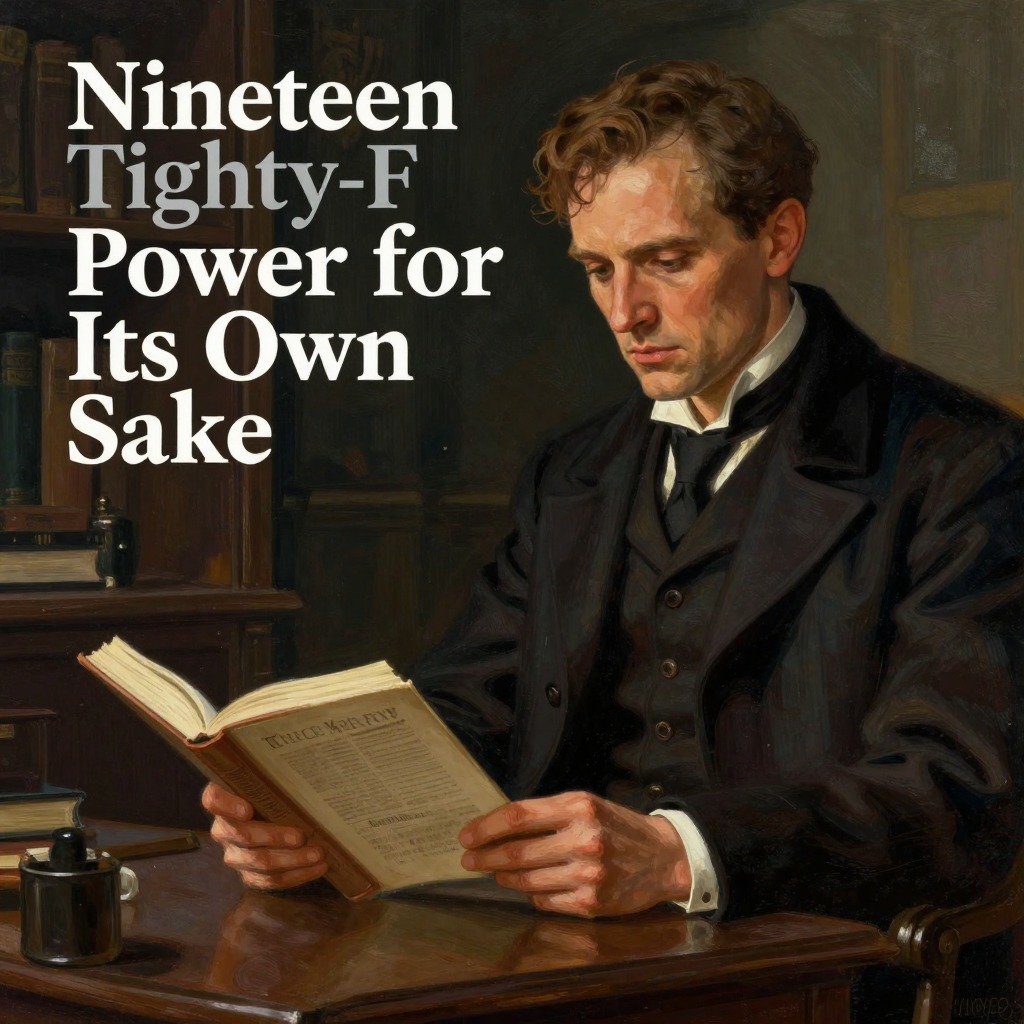
The Party seeks power entirely for its own sake
In Nineteen Eighty-Four, the doctrine that the Party seeks power entirely for its own sake is the central confession of the regime, spoken by O'Brien in the Ministry of Love at the climax of Winston Smith's re-education. It strips away every justification tyranny has ever offered — the good of the majority, the necessities of revolution, the promise of a future paradise — and declares that power is an end in itself, pursued for no motive beyond its own exercise. Everything else in Oceania's system, from the rewriting of history by the Ministry of Truth to the torture chambers of the Ministry of Love, follows from this single principle, and its final proof is Winston's last act: not death but love, when he gazes at the enormous face and knows that he loves Big Brother.
Definition and Statement
O'Brien announces the principle during the second stage of Winston's re-integration, after dismissing the idea that the Party rules for the good of the majority. "The Party seeks power entirely for its own sake," he explains; "we are interested solely in power. Not wealth or luxury or long life or happiness: only power, pure power." He completes the thought with a chain of identifications: "Power is not a means, it is an end. One does not establish a dictatorship in order to safeguard a revolution; one makes the revolution in order to establish the dictatorship. The object of persecution is persecution. The object of torture is torture. The object of power is power." The same creed appears in his self-description as one of the "priests of power," for whom "God is power." Winston, hearing it, is struck by the tiredness of O'Brien's face, yet understands that the worn body belongs to a being in all ways larger than himself, a mind that long ago examined and rejected every idea he could ever have.
The Meaning of Pure Power
This motive explains the peculiar character of Oceania's cruelty. Power, as O'Brien defines it, is power over human beings, exercised above all through the mind; its instrument is suffering, because "obedience is not enough. Unless he is suffering, how can you be sure that he is obeying your will and not his own?" He describes a world founded on hatred rather than love or justice, "a world of fear and treachery and torment," in which progress means progress towards more pain and no emotions survive except fear, rage, triumph and self-abasement; its emblem is "a boot stamping on a human face - for ever." The Ministry of Love embodies this logic architecturally: a windowless fortress protected by barbed-wire entanglements, steel doors and hidden machine-gun nests, impossible to enter except on official business. There the Party does not merely destroy its enemies but changes them, making "the brain perfect" before it is blown out, because it is intolerable that an erroneous thought should exist anywhere in the world.
The Break with Earlier Tyrannies
O'Brien insists that this is what separates the Party from all previous oligarchies. The German Nazis and the Russian Communists came close in method, but "never had the courage to recognise their own motives"; they pretended, perhaps even believed, that they had seized power unwillingly and for a limited time, with a paradise waiting just round the corner. The Party knows better and admits what it is. The confession echoes George Orwell's own diagnosis of the twentieth-century Left, which he accused of accepting the Russian regime as socialist while knowing that its spirit and practice were alien to socialism — a "schizophrenic manner of thinking" in which democracy could bear two irreconcilable meanings and concentration camps could be right and wrong simultaneously. That split mind is the political soil from which the principle grows: once ideology is detached from truth, power needs no purpose beyond itself.
The Doctrine at Work in Oceania
The principle is not confined to the confession chamber; it pervades the daily life of Airstrip One. Emmanuel Goldstein, the Enemy of the People, is hated and despised everywhere, his theories refuted a thousand times a day, yet his influence never grows less, and a day never passes without spies and saboteurs acting under his direction being unmasked by the Thought Police — a manufactured threat that keeps the machinery of power in motion. The Ministry of Truth, whose business is to deny the memories of others and rewrite the past until the lie becomes truth, works alongside the Ministry of Love to make the past whatever the Party needs it to be. The same indifference to truth governs economics: the Ministry of Plenty announces that the standard of living has risen by twenty per cent and that the chocolate ration has been raised to twenty grammes a week at the very moment when, as Winston knows, it is being reduced from thirty grammes to twenty, and the lie is swallowed because the point is not prosperity but the demonstration of control.
Fulfillment in Winston Smith
The doctrine reaches its completion in Winston's conversion. After the rats of Room 101 have made him scream "Do it to Julia! Do it to Julia! Not me!", O'Brien tells him that it is not enough to obey Big Brother: he must love him. In the Chestnut Tree Café, listening to the victory bulletin from the African front, Winston finally understands what kind of smile is hidden beneath the dark moustache. "He had won the victory over himself. He loved Big Brother." The Party has achieved the pure power it sought: not the power to kill him, but the power to make him desire his own obliteration. The doctrine that power is an end in itself is proven by the only test that matters to the Party — a heretic who no longer needs to be forced, because he has been remade.